
Glass railings and partitions in West Palm Beach
Railings that hold a view open instead of interrupting it, and interior partitions that divide a room without closing it in — specified for the load and the salt air they actually face.
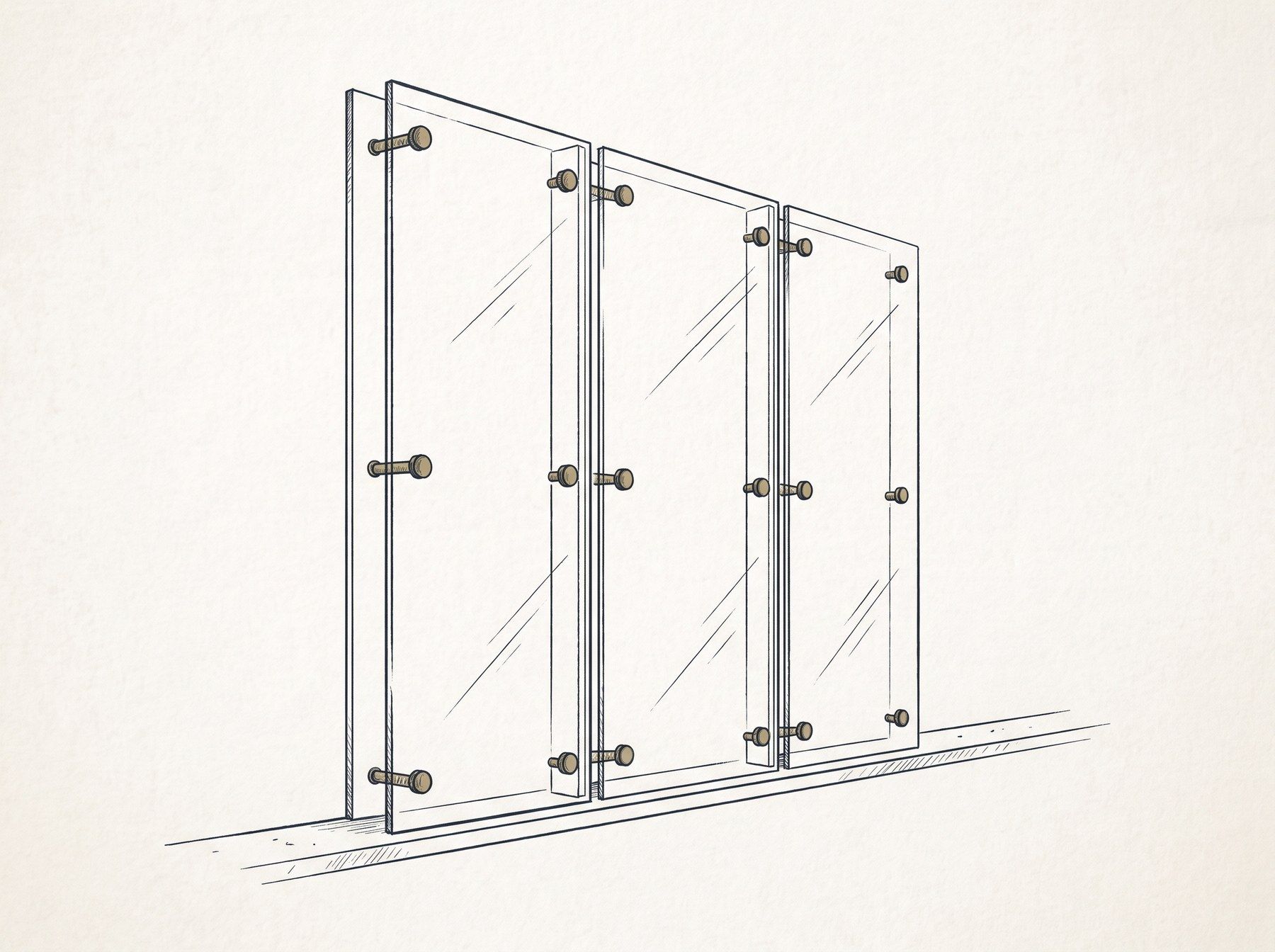
Two very different jobs on one page
A glass railing is a guard. It exists to stop a person going over an edge, it carries real load, and it is governed by code. A glass partition divides an interior space and carries nothing but itself. They both end up as panels of glass with hardware, which is why they sit together here, but almost nothing about how they are specified is shared.
Glass railings
Along a balcony, a pool deck, a terrace or a stair, a glass railing does the thing no other guard can: it meets code without taking the view away. That is the entire reason to choose one, and it is worth doing properly, because a railing that is wrong is not a cosmetic problem.
- Base shoe — a continuous channel anchored along the edge that the glass sets into and is shimmed and locked within. A clean, well-proven way to run frameless glass along a straight edge.
- Standoffs — individual fixings that hold the glass off a face, typically along a slab edge or a stair stringer. Lighter looking, and it puts concentrated load into each fixing point, so what is behind them matters even more.
- Posts and clamps — glass held between spaced posts. The most tolerant of an imperfect substrate and usually the least expensive.
- Top rail, or none — a capping rail spreads load along the run and relaxes what the base has to do. Leaving it off is the cleaner look and asks more of everything else.
Hardware, and why the coast decides it
On a railing the metal fails long before the glass does. Salt air a few blocks from the Atlantic will find any fixing not specified for it and leave rust weeping down the glass within a season — and on a guard, corroded fixings are a structural matter, not a cosmetic one. Stainless steel is a family of alloys, not a single material, and they differ substantially in marine performance. How close the job is to open water changes what we specify, so it is a question we ask early.
Interior glass partitions
A partition divides without closing. It keeps daylight moving through a floor plan, which is the usual reason to choose glass over a stud wall in a home office, a study or a converted room.
- Fixed panels, floor to ceiling or above a low wall.
- Hinged or sliding glass doors within the partition run.
- Clear, low-iron, frosted, obscure or tinted glass, depending on how much privacy the room needs against how much light it wants to keep.
Worth being straightforward about the limitation: a glass partition divides sight, not sound. If the point of the wall is to make a room quiet, glass is the wrong material and we will say so.
How the job runs
- Look at the substrate first. For a railing this comes before anything else — what the glass anchors into determines which system is even possible. For a partition, the check is that the opening is square and the floor is level.
- Confirm what code requires for the guard, including the exterior wind provisions where they apply.
- Measure the finished opening. Tempered and laminated glass cannot be trimmed on site, so measurements are taken once the surrounding finishes are on.
- Fabricate — panels cut, edges polished, any holes or notches made, then tempered and laminated as specified.
- Install — hardware set into the substrate, panels seated, plumbed and locked, doors hung and adjusted.
What it costs
Railings are priced by the length of the run, the system, the glass thickness and make-up, the hardware finish and grade, and what the anchoring substrate turns out to be. A posts-and-clamps run on sound concrete is the least expensive; a frameless standoff railing in laminated glass with marine grade fixings is the most. Partitions are priced on area, the door and the glass type.
Where we work
New Shower Doors Unlimited installs glass railings and partitions throughout West Palm Beach and across Palm Beach County, Broward County, Martin County. Related work: wine cellar glass, commercial and new construction glass and frameless shower doors.
Common questions
Does a glass railing need a top rail?
Not always, and it is the first thing worth settling. A railing with a continuous top rail spreads load along the whole run and is the more forgiving assembly. A true frameless railing with no top rail relies entirely on how the glass is anchored at the base, uses thicker glass, and is less tolerant of a substrate that cannot take the load. Both are done. Which one your opening can carry depends on what is underneath it.
What glass is used for a railing?
Railing glass is tempered, and for most guard applications it is laminated as well — two tempered panes bonded to an interlayer, so that if a pane breaks the interlayer holds the pieces in place instead of the opening becoming a hole. That is the difference between a shower panel and a barrier someone can lean against above a drop.
Will a glass railing survive being near the ocean?
The glass will. The hardware is the part that decides, and salt air near the coast is unforgiving of the wrong metal. Stainless is not one thing — grades differ substantially in how they handle a marine environment, and fixings that are fine inland will show rust stains within a season a few blocks from the water. Tell us how close to the ocean the job is and it changes what we specify.
What does a railing have to be anchored into?
Something structural. Base shoe and standoff systems both transfer real load into the substrate, so concrete, a properly built slab edge or blocked framing are what they want. A railing fixed into tile, a thin topping or unblocked decking is not a railing. If the substrate is unknown, that gets checked before anything is quoted rather than discovered on installation day.
Are glass partitions the same thing?
Structurally, no. An interior partition is not a guard — it is not stopping anyone falling — so it is a lighter assembly and the constraints are about the opening, the door and the acoustics rather than load. We install both, but they are specified quite differently.
Does a railing have to meet code?
Yes, and this is not the place to improvise. Guards have height, load and infill requirements, and glass used as a guard has its own rules on top of that. Florida’s coastal wind provisions apply to exterior work as well. We build to what the job requires and the permit calls for.
Get a price for glass railings & partitions
Send the opening dimensions and a photo if you have one. A photo is usually enough for us to tell you what will fit and what it costs before anyone drives out.
Have a run to railing?
Send the length of the run, what the glass would anchor into, and roughly how close to the water it is. Those three answers cover most of the specification.